What the Photograph Shows vs. Crystal Geometry
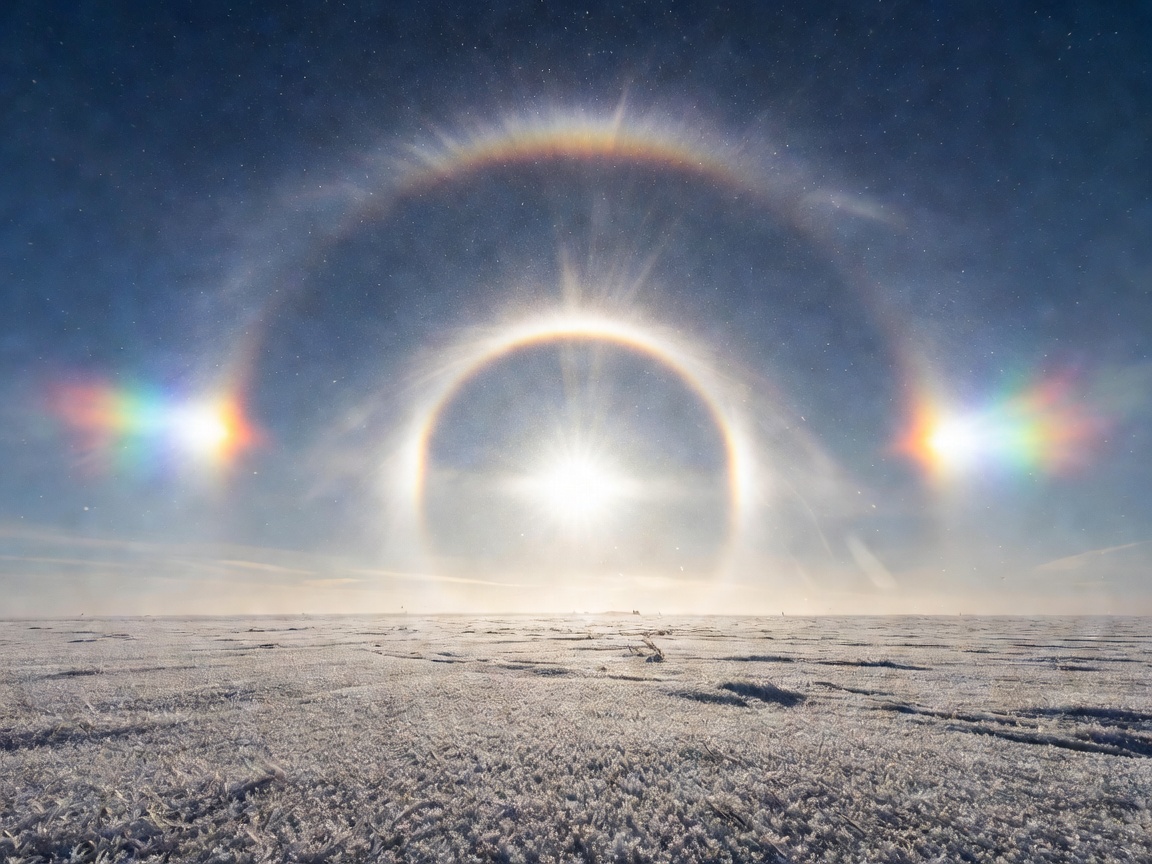
When a wide-angle photograph captures two brilliant luminous patches flanking a low winter sun—connected by a faint ring and topped by an inverted smile of pure spectral color—casual captions often call it "three suns." Physically, only one light source exists. Millions of drifting hexagonal ice crystals in cirrostratus or polar diamond dust act as miniature glass prisms.
As documented in Marcel Minnaert's classic treatise Light and Color in the Outdoors and modern ray-tracing simulations, ice crystals in the upper troposphere predominantly grow into two habits depending on temperature and supersaturation: flat hexagonal plates and elongated hexagonal columns. Aerodynamic drag aligns larger falling plates horizontally like fluttering leaves (around 100 to 500 micrometers across), whereas tiny crystals below 20 micrometers tumble randomly due to Brownian motion and micro-turbulence.
-
60° Prism Wedge (22° Halo & Parhelia)
Light entering one side face of a hexagonal crystal and exiting an alternate side face traverses an effective 60-degree wedge. Minimum deviation for yellow-red light in ice (refractive index 1.31) equals 21.8 degrees. Random orientations draw a full circle; horizontal plates concentrate light left and right of the sun as sundogs (parhelia).
-
90° Right-Angle Faces (Circumzenithal & 46° Arcs)
Rays entering the flat top basal face of a horizontal plate and exiting a vertical side face traverse a 90-degree prism, producing the remarkably pure colors of the circumzenithal arc high overhead—provided solar elevation stays below 32.3 degrees.
Ray Path: 60° Hexagonal Ice Plate
Thermal Inversions, Mirages & the Green Flash
Air density decreases as temperature rises, altering air's refractive index by fractions of a percent. Over long grazing paths near the horizon, those tiny gradients bend light rays over tens of kilometers.
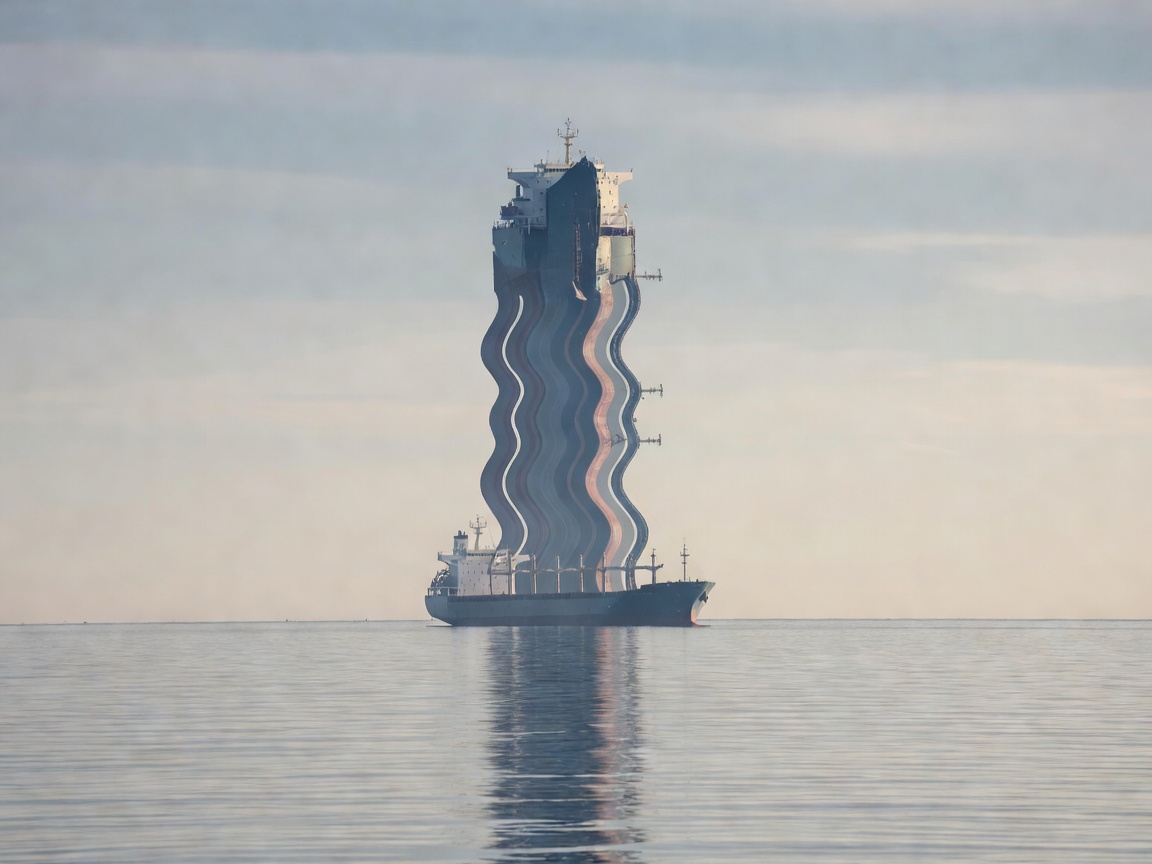
In an inferior mirage across sun-baked asphalt, rays curve upward so sky light appears on the road like shimmering water. Conversely, when warm air slides over frigid polar water or spring Great Lakes surfaces, a steep thermal inversion bends rays downward matching or exceeding Earth's curvature. When multiple alternating warm and cool ducts stack vertically, a single ship hull or island cliff is alternately compressed, inverted, and stretched into a Fata Morgana—explaining centuries of phantom-island charts and "floating ship" photographs.
At sunset over an unobstructed marine horizon, atmospheric dispersion separates the sun's green/emerald upper rim slightly higher than its red rim while Rayleigh scattering removes violet wavelengths. A ducting inversion momentarily magnifies that upper rim for one to two seconds into a distinct green flash.
Diagnostic Comparison of Sky Optics
Use solar position, viewing direction, and angular radius to classify optical photographs accurately in the field.
| Phenomenon | Medium Required | Viewing Direction | Angular Radius / Solar Limit | Key Visual Clue |
|---|---|---|---|---|
| 22° Halo | Randomly oriented hexagonal ice | Toward the sun or moon | 22° radius; any solar altitude | Darker sky inside ring (Alexander-like shadow zone); red inner edge |
| Circumhorizontal Arc | Horizontally aligned ice plates | Below the high sun | 46° below sun; sun > 57.8° high | Parallel to horizon; impossible at high latitudes in winter |
| Circumzenithal Arc | Horizontally aligned ice plates | High overhead toward sun | Near zenith; sun < 32.3° high | Inverted rainbow smile; red outer edge facing sun |
| Solar Glory | Uniform liquid cloud droplets (10–25 µm) | Antisolar point (sun behind observer) | 1° to 5° concentric rings | Always centered on aircraft shadow or observer's head shadow |
| Cloud Iridescence | Freshly condensed uniform droplets | Within ~15°–30° of sun | Irregular pastel patches | Mother-of-pearl bands tracing lenticular or pileus cloud contours |