Reading a Hailstone in Hand—and Under Polarized Light
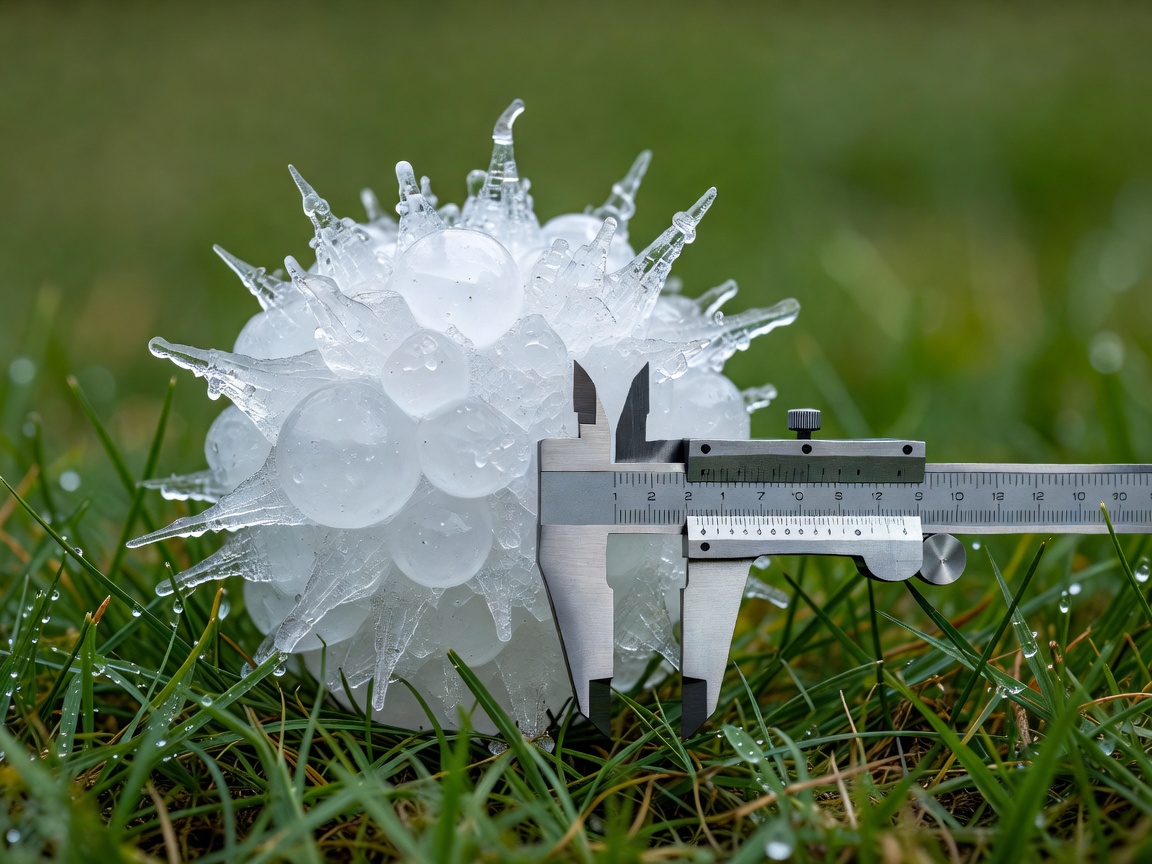
Hold a newly fallen 12-centimeter hailstone beside a millimeter scale—never a coin or golf ball alone, whose perspective shifts with camera distance—and two details stand out: radiating finger-like icicle lobes and concentric internal rings of milky and transparent ice. For decades, popular science diagrams explained these rings by claiming hailstones fall out of a storm, get sucked back up to freeze clear water, and repeat five or six vertical cycles.
Trajectory modeling and isotopic analysis led by researchers at the NOAA National Severe Storms Laboratory (NSSL), NCAR, and the Insurance Institute for Business & Home Safety (IBHS) demonstrate a far more coherent physical path. Inside a rotating supercell mesocyclone, updrafts are tilted and wide—often 8 to 15 kilometers across. Graupel or frozen raindrop embryos enter along the updraft periphery and glide horizontally across the vault between −10 °C and −30 °C where upward wind speed closely balances the growing stone's terminal fall speed.
-
Schumann–Ludlam Limit (Wet vs. Dry Shells)
Every gram of supercooled liquid water freezing onto a hailstone releases 334 joules of latent heat. When liquid water concentration is modest or air is very cold, heat conducts away quickly: droplets freeze instantaneously on impact, trapping tiny air bubbles as opaque white ice (dry growth). Entering a liquid-rich core pushes surface temperature to 0 °C, leaving a thin water skin that freezes slowly without air bubbles into transparent ice (wet growth)—creating rings during a single horizontal pass.
-
Why Giant Stones Grow Spiky Lobes
Tumbling through wet-growth regions, meltwater flows hydrodynamically toward low-pressure zones on the stone's wake and equatorial edges, forming icicle-like cusps that capture even more supercooled droplets by increasing surface area without adding proportional density.
Single-Pass Supercell Hail Trajectory
Three-Body Scatter Spikes & Bounded Weak Echo Regions
From the ground, a hail-producing supercell often displays a striated corkscrew updraft tower and a dense, pale-white or aquamarine precipitation shaft (sometimes called a "hail fog" once stones blanket warm soil). Yet photographs of the exterior cloud wall cannot distinguish 2-centimeter pea-to-walnut hail from 15-centimeter roof-penetrating ice.
Operational meteorologists rely on S-band dual-polarization radar signatures: extremely high reflectivity (>65 dBZ) paired with near-zero differential reflectivity (ZDR) because tumbling giant stones appear roughly isotropic compared to flattened raindrops, lowered correlation coefficient (CC) from mixed wet/spiky shapes, and a radially elongated Three-Body Scatter Spike (TBSS) artifact downrange of the core where radar pulses bounce from giant ice to the ground and back via the hail core.
Verified Benchmark Hailstones
-
Vivian, South Dakota, USA (23 July 2010)
Official US diameter record: 20.3 cm (8.0 in) across, 47.3 cm circumference, mass 0.879 kg (1.9375 lb)—despite partial melting prior to freezer preservation.
-
Gopalganj District, Bangladesh (14 April 1986)
WMO-recognized world mass record: verified specimen weighed 1.02 kg (2.25 lb) during an intense pre-monsoon supercell along the dryline-moist Bengal convergence zone.
-
Villa Carlos Paz, Córdoba, Argentina (8 Feb 2018) & Azzano Decimo, Italy (24 July 2023)
Peer-reviewed photogrammetry in Córdoba estimated maximum stone span between 18.8 and 23.7 cm; Northern Italy's 2023 Po Valley supercell yielded a verified 19.0 cm European record.
Observing Hail Safely & Scientifically
Never stop beneath highway overpasses during hailstorms; wind-driven stones funnel through underpass girders while blocking emergency lanes. If documenting fallen specimens after a storm safely clears overhead (no thunder for 30 minutes), place the stone on dark grass next to a metric ruler, photograph orthogonal axes without wide-angle lens distortion, and seal in double freezer bags if reporting to national meteorological networks such as CoCoRaHS or ESWD.
Next: Electrified, Rotating Atmospheres →